
CONTRAPARED | EUROPEAN DEAF PADEL | SEVILLE 2026
Some tournaments are defined by the noise of the crowd, the celebrations and the shouts of encouragement. Then there is what is happening at ICÓNICO Sports Social Club in Seville, where padel is experienced in a different way. Here, the sound of the ball hitting the racket, the glass walls and the court takes centre stage. You don’t need to hear to understand what is happening on court. You simply need to watch.
The European Deaf Padel circuit returned to action after just over a month since its previous event in Paris. Seville welcomed a first day full of nerves, reunions, excitement and the desire to compete again. Players and pairs from different parts of the world gathered to secure their places in the final draws across three categories, both men’s and women’s.
The tournament has brought together athletes from more than 21 countries, including the United States, Argentina and numerous European nations, with representatives from Lithuania, Russia and Ukraine. It is an impressive international community that highlights the growing reach of this discipline.
Twelve courts, hundreds of players and a surprising way of communicating
Walking into the ICÓNICO indoor venue, with its twelve courts and hundreds of people sharing the same passion, offers an unforgettable experience for anyone unfamiliar with this type of competition.
The first thing that stands out is the atmosphere. There are no constant conversations between players or the usual verbal instructions exchanged during a rally. Instead, the dominant sounds are racket contact, the ball bouncing off the glass and, occasionally, a shout of encouragement or spontaneous applause.
But after watching just a few rallies, it becomes clear that communication is always present, even if it takes a different form.
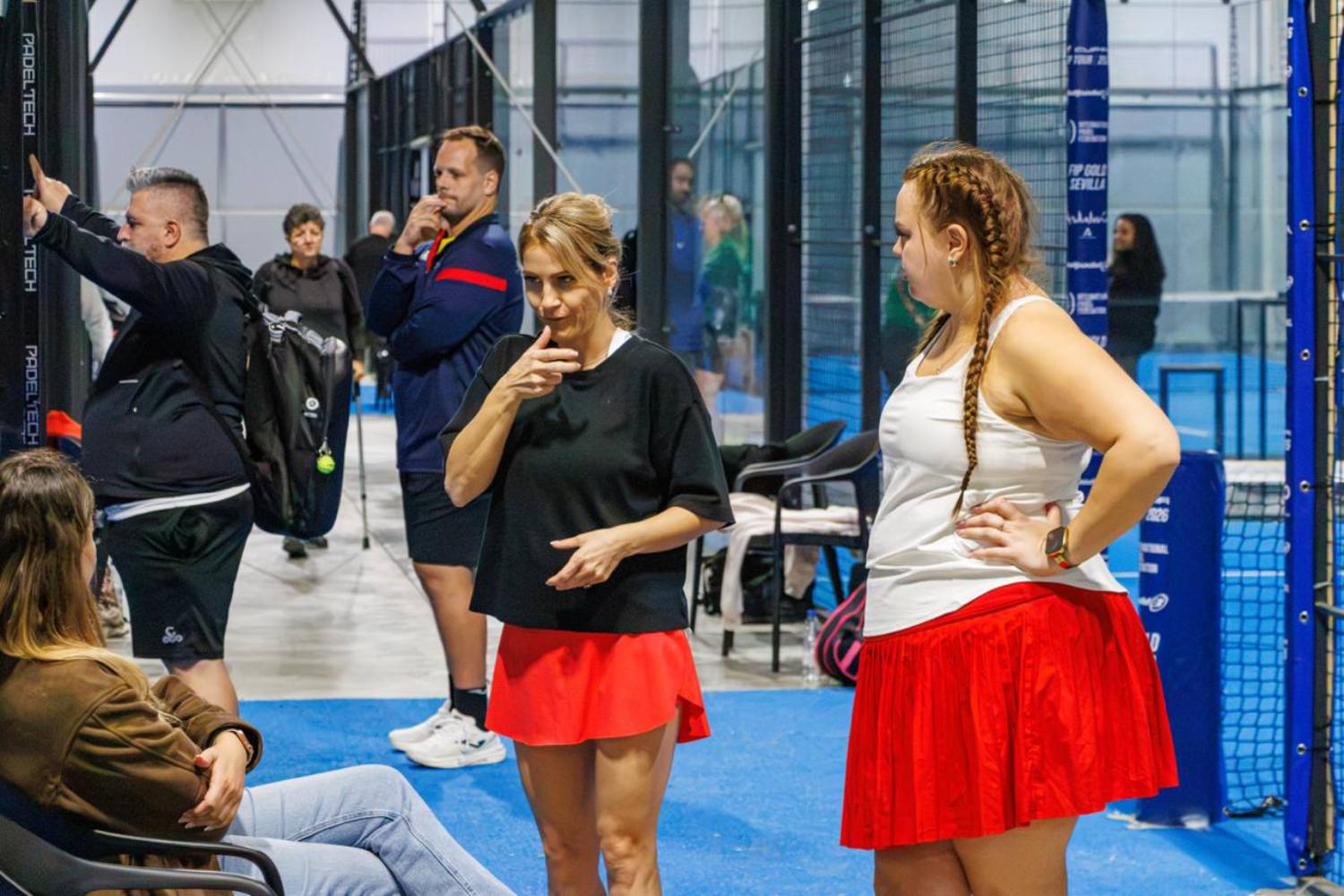
Partners understand each other through gestures, eye contact and perfectly coordinated signals. At the beginning of each game, players use their fingers to indicate the current set score. They also communicate the points with their hands, using visual signs for 15, 30 and 40.
Coordination between partners is particularly impressive. They prepare their moves, look for each other and communicate instructions without needing to speak. It is non-verbal communication that often works with remarkable naturalness and precision.
Players of different ages and competitive levels are also taking part. In some matches, an additional person is required on court to keep score and help everyone follow the match, another distinctive feature of the competition.
A tournament with its own characteristics
The European Deaf Padel competition has several specific features worth knowing.
All games use the golden point at 40-40, eliminating advantages and adding excitement to decisive moments.
Matches are played as best-of-three sets, all with tie-breaks. Consolation matches follow a different format: two sets and, if required, a ten-point super tie-break.
Another interesting feature is the so-called courtesy matches. Pairs eliminated in the main draw quarter-finals continue competing to determine their final tournament position. Third-place matches are also played.
The organisers have also had to adapt to particularly high participation. For the first time, a qualifying round has been introduced in the third category due to the number of registered pairs whose classification was not initially established. Winners progress to the Third A main draw, while the remaining pairs enter Third B.
To manage such a large competition, the tournament referee has sheets containing photographs and names of all players. This practical system makes identification easier and speeds up court and schedule allocation.
Platinum reaches the semi-final stage
On the sporting side, the men’s Platinum category promises some exciting semi-finals.
Spanish players Miguel Hernando Martínez and Denis Álvarez will face another strong pair, Alejandro Abadía and Thomas Gifliuzzi. Their match is scheduled for 12:45 pm.
In the other half of the draw, Maxime Sánchez and Nicolas Lanfranchi are awaiting their opponents for the second semi-final, also part of Saturday’s decisive schedule.
In the women’s Platinum draw, the semi-finals begin at 11:30 am. In the upper half, Celine Cornia and Sylvie Moustashine will take on Gili Goldhorn and Debora Perazzoli.
In the other semi-final, Spain’s Raquel Pitarch, alongside Germany’s Melissa Schuster-Gracic, will be looking for a place in the final against Manon Mallieu and Susana Ricci Bitti.
Saturday brings finals day to ICÓNICO
Saturday, 21 November, will begin at 9:00 am with the finals across the different categories. It promises to be a busy morning as the competition moves towards its most eagerly awaited matches.
The main-draw finals are scheduled to start at 5:30 pm, with the women’s final followed by the men’s final. Matches will be broadcast live on the official European Deaf Padel YouTube channel.
The Platinum finals are also scheduled for 7:00 pm.
Seville is experiencing much more than a sporting competition. It is discovering a different way of communicating on a padel court, where gestures replace words and every point is played with the same intensity, passion and competitive spirit found in any other tournament.
Because padel does not need sound to create emotion. And at ICÓNICO, the opening day has made that perfectly clear.